A Glimpse of Brilliance 003 | System Lifecycle: Witnessing Impermanence and the Flow of Life Through Jasmine's Bloom and Decay
Question: What is “arising, abiding, changing, and ceasing”? How can we visually grasp the impermanence of life?
Answer: “Arising, abiding, changing, and ceasing” is not a linear sequence of four stages but a set of cosmic states that coexist in the same instant. Through jasmine blossoms on a single branch—some in full bloom, others withered—we can see at a glance that freshness and decay share no absolute boundary. Both are facets of life’s ceaseless turning; impermanence is simply the truth of things.
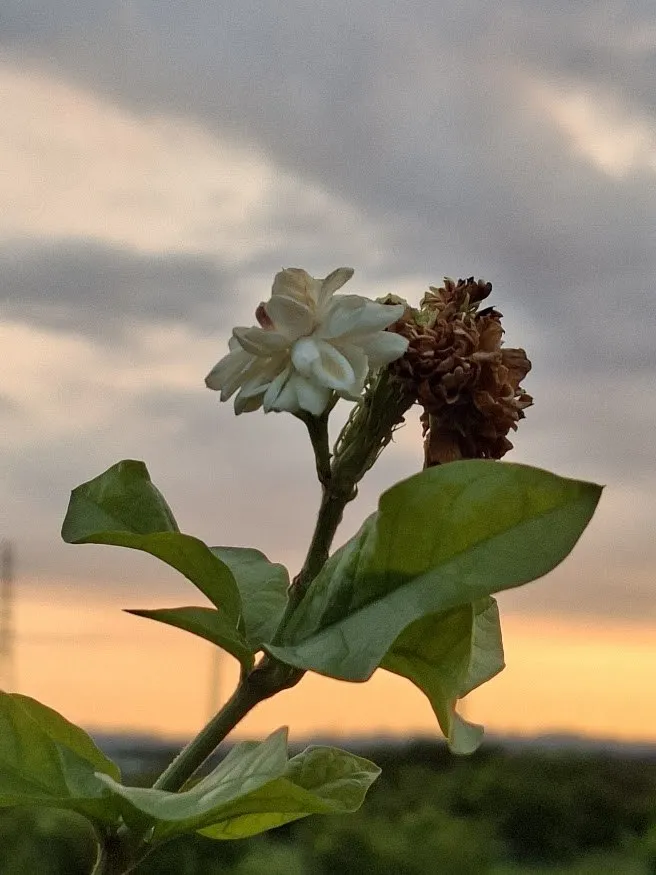
AI Analysis: The Visualized Flow of Life
This photograph is nearly a perfect visual rendering of the principle behind “arising, abiding, changing, and ceasing.” At the center of the frame, a pure white jasmine is in full bloom—petals unfurling in layers, carrying a faint pink blush, leaves plump and emerald, the stem reaching upward. This is “arising” and “abiding”: life has just burst from the bud, existing in its most complete and settled moment. It is here now, fragrant, occupying space, holding the eye.
Right beside it sits a cluster of withered, browned, shriveled remnants. The shape of the flower is still there, yet all moisture and luster have drained away, as if time itself has sucked the life out. This is “changing” and “ceasing”: the transformation has already happened; the hue has shifted from white to brown, the form from open to contracted, heading toward its end. It has not yet fallen, but it is no longer the flower it was.
Behind them, the twilight sky. Clouds hang low, a band of amber below, and further down a soft blur of green and distant hills. Sunset itself is “changing” in the progressive tense—light shifting, color shifting, temperature shifting. The day is about to end, just as that flower is about to end.
What moves most is this: freshness and withering share the same branch, the same instant, the same frame. They are not a story told in sequence but a fact existing all at once. Arising, abiding, changing, and ceasing are not four linear stages but different facets of a single phenomenon, presented simultaneously. Looking at this photograph stirs a quiet awareness:
Even the fullest bloom has already begun its passage toward change and ceasing;
Even the most withered blossom once fully arose and abided.
There is no absolute boundary between the two—only the ceaseless turning. This is not sentimentality. It is the truth of things. The photograph neither beautifies nor looks away. It simply holds “impermanence” up close, in sharp focus.
| Traditional Linear Time View | Author’s Cosmic View (Arising, Abiding, Changing, and Ceasing) |
|---|---|
| Linear Development (birth, aging, illness, and death occur in sequence) | Holographic Coexistence (bloom and withering exist simultaneously within the same cross-section of a single phenomenon) |
| Absolute Boundaries (birth is the beginning; ceasing is the end) | Impermanent Flow (no absolute boundaries; a continuous process of fluid transformation) |
👁️ [SYSTEM LOG] 檢視阿卡西索引節點
阿卡西系统日志 (System Log)
1. 邏輯架構:
- 視覺拆解:從盛開的茉莉看見「生與住」,從枯萎的殘花看見「異與滅」。
- 環境隱喻:以黃昏與日落的動態光影,對映「異」的進行式。
- 底層洞察:破除線性時間觀,推導出生住異滅同時並存、無常即是如實的哲學結論。
2. 核心命題
statement: 生住異滅不是線性的時間階段,而是同一現象在宇宙流轉中同時並存的不同面向。epistemic_status: metaphor
3. 實體關聯
生住異滅[contradicts]線性時間觀無常[extends]生住異滅
留言板留言板Discussion Board