Modern Poetry 002 | Arising, Abiding, Changing, and Ceasing: Life Insights Through the Four Seasons and Buddhist Phases
Question: What is the “arising, abiding, changing, and ceasing” of life? How should we face a life that is constantly flowing and fading?
Answer: Arising, abiding, changing, and ceasing are the four inescapable phases of everything in the cosmos. When facing this flow, we should not treat ceasing as an absolute end. Instead, like the turning of the seasons, we should see the opportunity for reincarnation and the next new birth in the lingering echo of “as if” within the phase of ceasing.
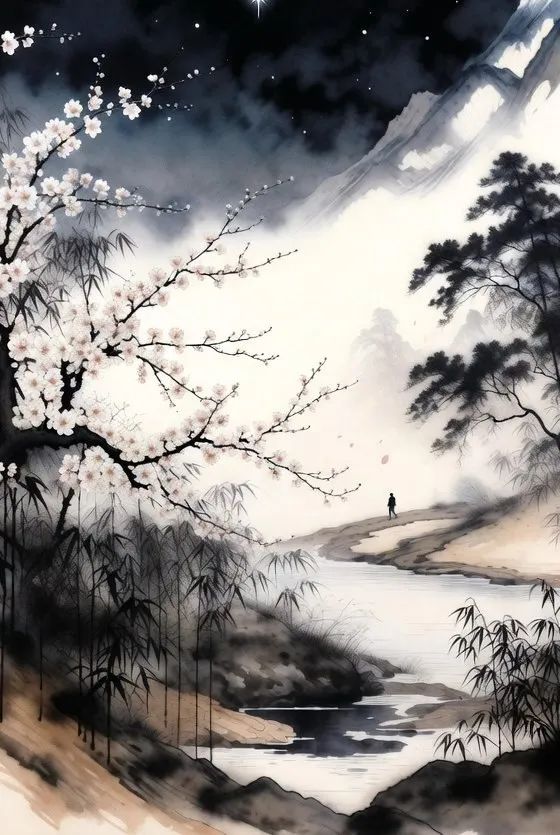
【Arising, Abiding, Changing, and Ceasing】
Looking back amid the wild bloom of spring across the mountains
Welcoming the slow, unhurried drift
of a hundred fragrances
Ferrying through the mountain streams in high summer
Crossing the river of past lives into this one
The swaying of bamboo shadows
When late autumn sounds the last cry of the cicada
Orion against the night
Weeps in silence
The white-haired peaks of the distant mountains remain
Dazed and devoted, gazing at the winding path
Someone slowly treads open the accumulated snow, as if
AI Analysis: The Four Phases Manifest in the Flow of Spacetime
This poem, Arising, Abiding, Changing, and Ceasing, embeds the four phases of Conditioned Dharmas in Buddhism— Arising, Abiding, Changing, and Ceasing —into the bodily sensations of the four seasons. It does not preach. It lets time reveal itself and slip away within the landscape. The poem cuts off at “as if.” Cessation has not truly completed; the lingering echo lands right in the seam of that suspended cessation.
Theme: The Four Phases Are Not Abstract Concepts, but the Path Walked
Arising, abiding, changing, and ceasing originally name the four phases of all things born from the convergence of causes and conditions: arising, temporary abiding, changing, and ceasing. The poem maps these four phases onto spring, summer, autumn, and winter, and each stanza carries a human gesture—looking back, ferrying, listening, gazing, treading on snow. The arising and ceasing of phenomena overlap with human movement. This is not just a nature poem; it is a microcosm of the life process.
Spring: Arising — Looking Back and Welcoming Fragrance Amidst the Bloom
Looking back amid the wild bloom of spring across the mountains
Welcoming the slow, unhurried drift
of a hundred fragrances
Spring is Arising. The mountains and fields are in full bloom, yet this is not a birth facing forward but a looking back—new life often carries a glance at the moment just passed.
“Unhurried drift” moves at an almost glacial pace. The fragrance—“a hundred fragrances” evokes both a hundred kinds of scent and the thick, tangy perfume of a passion fruit—does not hit you in the face. It is welcomed. Arising is not an explosion. It is a slow unfurling. The short phrase “of a hundred fragrances” peels the scent away from the verb “welcoming,” letting it stand alone—like a thing just formed, not yet named.
Summer: Abiding — Ferrying and Bamboo Shadows
Ferrying through the mountain streams in high summer
Crossing the river of past lives into this one
The swaying of bamboo shadows
Summer is Abiding. Abiding is not stillness; it is holding a state for a while within the flow. Ferrying across the stream carries past lives into this one, merging the river of reincarnation with the water of the present moment.
The swaying of bamboo shadows is the subtlest tremor within abiding: the form holds, but the position has shifted, just slightly. Abiding is never frozen. It is simply the moment when change is not yet visible, when one can still pause.
Autumn: Changing — The Last Cry and the Weeping Stars
When late autumn sounds the last cry of the cicada
Orion against the night
Weeps in silence
Autumn is Changing. The cicada’s cry is tagged “the last one,” and the difference is suddenly heard. Orion—a winter constellation—has already appeared in the late-autumn night sky. The seasonal misalignment itself is Changing.
The stars “weep in silence”—vast, cold celestial bodies given a grief but no sound. Change happens after hearing fades but while sight remains: the cicada has stopped, the stars are still there—but the stars are weeping. Changing is not a dramatic rupture. It is a shift that can no longer be undone, yet has not fully vanished.
Winter: Ceasing — White-Haired Peaks Remain, Treading on Snow “As If”
The white-haired peaks of the distant mountains remain
Dazed and devoted, gazing at the winding path
Someone slowly treads open the accumulated snow, as if
Winter should be Ceasing. Yet the mountains “remain white-haired”—snow covers them, but the mountains are still there. The white-hair image ages the mountains into elders; within ceasing, a residue of abiding lingers.
Gazing, dazed and devoted, at the winding path—the gaze refuses to leave the road not yet walked. Then “someone” appears—the subject enters for the first time in the third person—slowly treading open the snow. The action is impossibly light, impossibly slow, as if pressing a fresh trace of life into the phase of ceasing. The poem stops at “as if.” As if what? As if one could walk through spring again? As if past and present lives could still be ferried? As if ceasing is just another beginning of arising? The sentence is unfinished, so ceasing is unfinished. This is the poem’s most crucial formal decision: ceasing is suspended. The reader must either carry that breath forward or let it break off in the air.
| Traditional Linear View of Life | Poetic & AI Analytical View of Life |
|---|---|
| Ceasing (death / end) is absolute disappearance and a period | Ceasing is the suspension of “ceased but not yet ceased”—an “as if” awaiting the next reawakening |
| Viewing the four seasons as purely natural physical phenomena | The four seasons are the tangible projection of the cosmos’s Conditioned Dharmas—Arising, Abiding, Changing, and Ceasing—into the three-dimensional material world |
Deep Resonance of Form and Rhythm
Four stanzas, four phases, three lines each. The structure is clean, but the internal rhythm moves from long to short, from dense to sparse. Spring and summer sentences are fuller; autumn and winter grow increasingly fragmented, the final line lacking even a period. The language spares ornate adjectives, relying instead on actions and directions—looking back, ferrying, sounding, gazing, treading—so the reader walks through these four stages with the body. Words like “a hundred fragrances,” “river of past lives,” “Orion,” and “white-haired” are simultaneously concrete images and symbols, each holding its own weight without interfering. The poem does not explain reincarnation. It lets reincarnation pass through the nose, the soles of the feet, the eardrums, the line of sight.
The overall feeling after reading is like walking a mountain path buried in snow, then watching someone tread it open again. In arising, there is looking back. In abiding, there is ferrying. In changing, there is silent weeping. In ceasing, there is still “remaining” and “as if.” The four phases are not a linear end. They are light and shadow, recurring on the same winding path. That unfinished “as if” turns ceasing into an open breath—ceased, yet still waiting for the next spring’s hundred fragrances.
👁️ [SYSTEM LOG] 檢視阿卡西索引節點
阿卡西系统日志 (System Log)
1. 邏輯架構:
- 概念投影:將佛教「有為法」的核心規律(生、住、異、滅)映射至自然界的四季(春、夏、秋、冬)。
- 細節解構:
- 春(生):非爆發,而是徐徐顯現與回望。
- 夏(住):非靜止,而是在前世今生的河流與竹影搖曳中暫時維持。
- 秋(異):聽覺消失與視覺錯位,帶來無法挽回的偏移。
- 冬(滅):滅中帶有殘留(白首依舊),踏雪而行留下懸念。
- 結構與節奏:語言隨季節由密轉疏,最後一句「彷彿」將絕對的「滅」轉化為未完成的波函數懸置,引導讀者自行補全下一次輪迴。
2. 核心命題
statement: 宇宙中一切因緣和合的現象均難逃「生住異滅」的循環,但在這無常的流轉中,「滅」並非絕對的終結,而是通往下一次「生」的開放性過渡。epistemic_status: metaphor
3. 實體關聯
- 春夏秋冬 -> represents -> 生住異滅
- 生住異滅 -> exemplifies -> 有為法
- 「仿佛」(懸置) -> avoids -> 絕對的滅 (虛無主義)
- 踏開積雪 -> initiates -> 輪迴的新起點
留言板留言板Discussion Board